Shopify Product Content Gaps That Hurt AI Search Readiness
Find product-page content gaps that make Shopify catalogs harder for AI search systems to understand, with practical before-and-after examples.
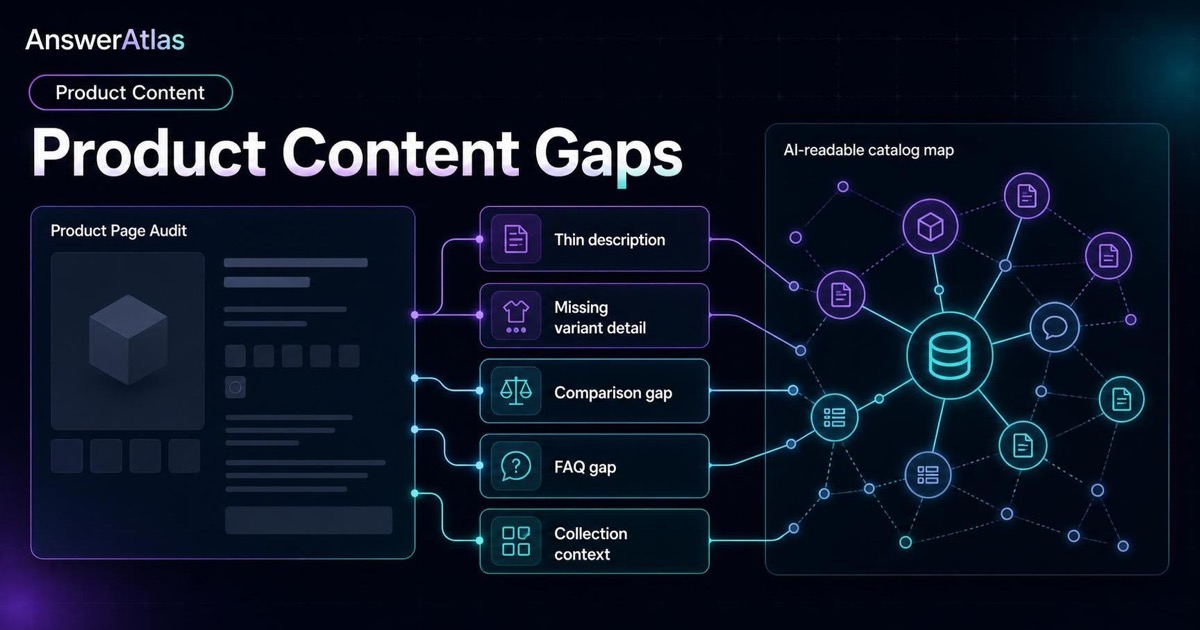
Many Shopify product pages were written for shoppers who already know what they want. They show a product name, a few lifestyle claims, a price, variants, and a buy button. That can work for repeat buyers, but it often leaves too much unsaid for search engines, AI answer systems, and shopping agents that need clear product facts.
AI search readiness is not about writing longer copy for every SKU. It is about making the product easier to understand, compare, summarize, and trust.
For Shopify teams, the most common content gaps usually fall into five areas:
1. Thin or generic descriptions. 2. Missing audience and use-case context. 3. Weak variant and comparison language. 4. FAQ gaps around purchase decisions. 5. Collection pages that list products without explaining the category.
Fixing these gaps can improve the page for shoppers and machines at the same time.
The Short Version
Start with your top products and ask whether each page answers the questions an AI system would need to summarize the product accurately.
| Content gap | Why it matters | What to add |
|---|---|---|
| Generic description | The page does not explain what makes the product distinct. | Specific use case, audience, material, size, fit, or outcome. |
| Missing buyer context | AI systems cannot infer who should choose the product. | "Best for" language and plain decision criteria. |
| Weak variant detail | Options look interchangeable or confusing. | Clear differences between size, color, bundle, material, or compatibility. |
| Missing comparison | The product is hard to place within the catalog. | Guidance on when to choose this product over adjacent options. |
| Thin FAQ coverage | Common purchase objections remain unanswered. | Short answers to sizing, care, shipping, warranty, setup, and compatibility questions. |
The goal is not keyword stuffing. The goal is useful product specificity.
Gap 1: Thin Or Generic Product Descriptions
A thin description may technically describe the product, but it does not give enough context to support confident understanding.
Common examples:
- "Premium quality for everyday use."
- "Designed with comfort and durability in mind."
- "A must-have addition to your routine."
- "Perfect for any occasion."
These lines could apply to almost anything. They do not explain the product, the customer, the problem, or the decision.
Before
Premium commuter backpack made with durable materials. Great for work, travel, and everyday use.After
A 22L commuter backpack for people who carry a 14-inch laptop, gym layer, water bottle, and compact tech accessories in one workday bag. The structured laptop sleeve, side bottle pocket, and front organizer keep daily items separate without making the bag feel oversized on a train or bike commute.The rewrite is not just longer. It adds capacity, audience, device fit, use case, and differentiators. Those details help shoppers decide and help machines summarize the product more accurately.
Gap 2: Missing Audience And Use-Case Context
Product pages often describe what the product is made from, but not who it is for or when it is useful.
AI search systems often need that missing layer. A shopper may ask for "a backpack for short office commutes," "a moisturizer for sensitive skin," or "a gift for new runners." If the product page never states the use case, the catalog becomes harder to match to those questions.
Useful context includes:
- Best-fit audience.
- Primary use case.
- Environment or occasion.
- Problem solved.
- Important limitation.
Before
Lightweight running jacket with water-resistant fabric.After
A lightweight running jacket for cool morning runs, light drizzle, and warm-up layers before races. It is designed for runners who want wind and splash protection without the insulation of a winter shell. For heavy rain or freezing conditions, choose a waterproof or insulated option instead.The limitation matters. It prevents the product from being over-positioned and gives AI systems a clearer boundary for recommendations.
Gap 3: Weak Variant Details
Shopify stores often have products with sizes, colors, materials, packs, subscription options, and bundles. If variant differences are only shown in a selector, the page may not explain how the options differ.
This is especially risky when variant choice affects:
- Fit.
- Capacity.
- Compatibility.
- Ingredients.
- Finish.
- Included accessories.
- Price or subscription cadence.
Before
Available in Small, Medium, and Large.After
Choose Small for daily essentials and compact crossbody carry, Medium for a tablet plus workday accessories, and Large when you need room for a 14-inch laptop and an extra layer. All sizes use the same water-resistant nylon, but the Large version adds a padded laptop sleeve.That explanation turns a selector into a buying decision. It also gives structured, reusable facts that can support FAQs, collection copy, and product schema QA.
Gap 4: Missing Comparison Context
A product page should not only explain the item in isolation. It should help shoppers understand where the product sits inside the catalog.
Comparison context is useful when:
- Two products target similar shoppers.
- One product is an entry-level version and another is premium.
- A bundle competes with a single item.
- Multiple materials, sizes, or formulas look similar.
- A new product replaces an older model.
Before
Our Everyday Tote is a versatile carryall for work and weekend plans.After
Choose the Everyday Tote if you want one open main compartment for work, errands, and short trips. Choose the Commuter Backpack if you need hands-free carry, laptop padding, and separate organization for transit. The tote is easier to pack quickly, while the backpack is better for longer walks or bike commutes.This kind of copy helps shoppers, support teams, internal links, and AI summaries. It also reduces ambiguity across the catalog.
Gap 5: FAQ Gaps Around Real Purchase Questions
FAQs are often added for SEO, but the strongest product FAQs answer objections and uncertainty.
Good product FAQ topics include:
- Size and fit.
- Compatibility.
- Materials and ingredients.
- Care instructions.
- Shipping constraints.
- Returns and warranty.
- What is included.
- When not to choose the product.
Weak FAQs repeat keywords. Strong FAQs reduce decision friction.
Before
Q: Is this a good backpack?
A: Yes, this backpack is a great choice for everyday use.
After
Q: Will this backpack fit a 14-inch laptop?
A: Yes. The Large size has a padded sleeve for most 14-inch laptops. The Small and Medium sizes are better for tablets, notebooks, and daily essentials.
The second answer is specific enough to be useful in a product page, support reply, or AI-generated answer.
Gap 6: Collection Pages That Only List Products
Collection pages can be powerful AI-readiness assets because they explain a category, not just one SKU. But many Shopify collection pages are only product grids.
A stronger collection page can explain:
- Who the category is for.
- How to choose between products.
- Key materials, sizes, formulas, or compatibility factors.
- Which products fit common use cases.
- Links to related guides, FAQs, and policies.
For example, a "Work Backpacks" collection should not only list products. It can explain how to choose by laptop size, commute type, organization needs, weather exposure, and carry preference.
That category context helps human shoppers and gives machines a clearer map of how products relate to each other.
A Practical Audit Checklist
Use this checklist for your top 10 to 25 Shopify product pages.
Product Clarity
- The first paragraph explains what the product is.
- The page names the target customer or primary use case.
- Important materials, dimensions, ingredients, or compatibility details are visible.
- The description avoids generic claims that could apply to any product.
- Product copy matches the product schema description.
Decision Support
- Variant differences are explained in plain language.
- The page helps shoppers choose between nearby products.
- Limitations are clear when they affect purchase fit.
- FAQs answer real buyer questions.
- Collection pages explain how to choose within the category.
AI Search Readiness
- Product facts are consistent across title, description, metadata, schema, and visible page copy.
- Important content is not hidden only behind scripts or unavailable tabs.
- Internal links connect products, collections, guides, and FAQs.
- Sitemap and canonical URLs expose the priority pages.
- Claims avoid guaranteed AI rankings, citations, or traffic outcomes.
What To Fix First
Do not rewrite the entire catalog at once. Start where the impact is highest.
Prioritize:
1. Best sellers with thin descriptions. 2. Products with many variants or frequent support questions. 3. Products with strong organic traffic but weak conversion. 4. Collection pages that cover important buying categories. 5. Products that should be eligible for AI-search discovery but lack schema or content clarity.
For each product, make the page more specific before making it longer. One useful paragraph, one comparison block, and three strong FAQs can be more valuable than a long generic description.
Where AnswerAtlas Fits
AnswerAtlas treats product content gaps as part of AI Search Readiness. A useful audit should show which product pages are unclear, where schema and visible content disagree, which FAQs are missing, and where collection context could make the catalog easier to understand.
Start with the products that matter most. If those pages clearly explain what the product is, who it helps, how variants differ, and when to choose it, the catalog becomes easier for shoppers and AI systems to read.
Next step
See how AI-readable your Shopify catalog is.
AnswerAtlas can scan product pages for AI-readiness signals such as structured data, catalog clarity, and crawler-friendly content.
Open Shopify App Store listing