How To Write FAQs That Help AI Search Engines Understand Shopify Products
Learn how to write Shopify FAQs that help AI search engines understand your products, with examples, structure tips, and common mistakes.
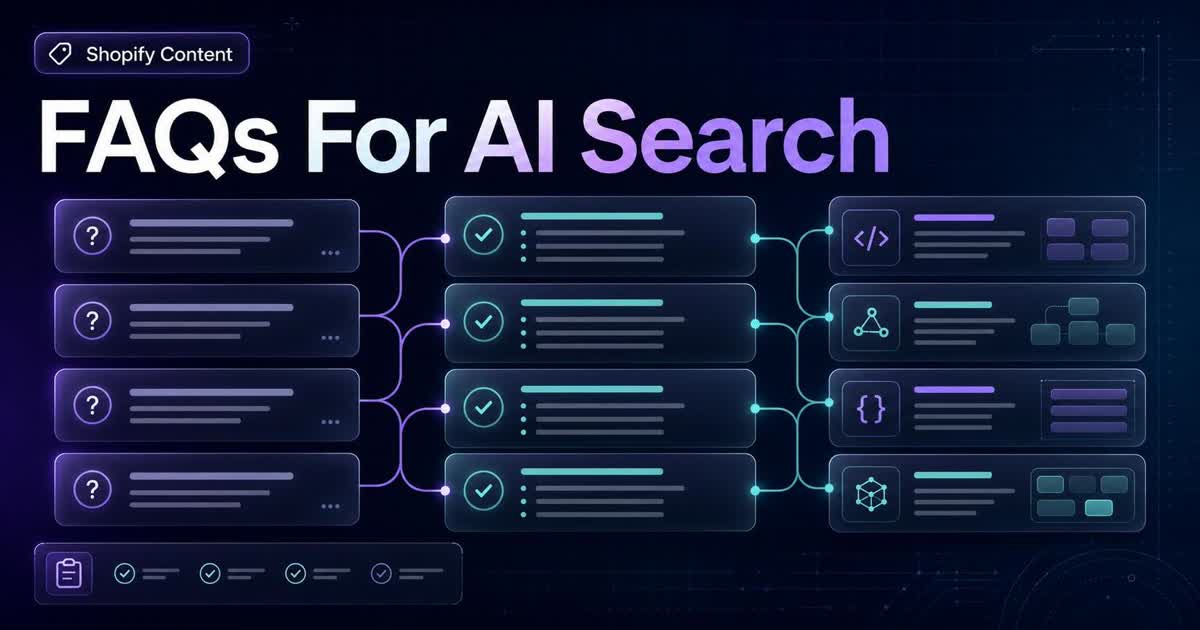
FAQs are often treated as a small SEO block at the bottom of a Shopify product page. That is a missed opportunity. A good FAQ can explain product fit, reduce ambiguity, and give AI systems clearer context about what the product is, who it helps, and when it is the right choice.
The goal is not to stuff a page with questions. The goal is to answer the real questions a shopper would ask before buying.
This guide shows how to write FAQ blocks that are useful to shoppers and easier for AI search systems to interpret.
The Short Version
A strong Shopify FAQ does three things:
1. It answers a real shopper question. 2. It includes product-specific facts instead of generic reassurance. 3. It matches the visible product page and schema instead of contradicting either one.
If a question does not help a shopper decide, compare, use, size, care for, or trust the product, it probably does not belong in the FAQ.
Why FAQs Matter For AI Search
AI search systems often need to summarize product pages into short, useful answers. When a page only has a title, price, image, and thin description, there may not be enough context to answer detailed questions.
FAQs help because they expose the product's decision points in plain language.
They can clarify:
- Who the product is for.
- Which size, variant, or bundle to choose.
- What is included in the box.
- How the product compares to similar options.
- What limitations, care steps, or compatibility details matter.
That does not guarantee an AI citation or ranking. It simply gives the page more useful facts to work with.
Start With Real Shopper Questions
The best FAQ questions usually come from places where shoppers hesitate.
Look for questions in:
- Customer support conversations.
- Product reviews and review replies.
- Live chat transcripts.
- Return reasons.
- Sales calls or wholesale inquiries.
- Product comparison pages.
- Internal notes from merchandising or fulfillment teams.
If you do not have much customer data yet, start with common purchase blockers: size, fit, compatibility, shipping, setup, care, ingredients, materials, warranty, and what is included.
Use A Question Pattern That Matches The Product
Not every product needs the same FAQ structure. Match the questions to the decision the shopper is making.
| Product type | Useful FAQ angle | Example question |
|---|---|---|
| Apparel | Fit, sizing, care, material | "Does this run small or true to size?" |
| Bags and accessories | Capacity, dimensions, use case | "Will this fit a 14-inch laptop?" |
| Supplements or skincare | Ingredients, timing, suitability | "When should I use this product?" |
| Electronics | Compatibility, setup, warranty | "Does this work with USB-C devices?" |
| Home goods | Dimensions, cleaning, installation | "Can this be used in a small apartment?" |
This keeps the FAQ tied to the product instead of turning it into a generic keyword block.
Write Answers With Specific Facts
Weak FAQ answers are usually too short, too vague, or too promotional.
Weak answer
Q: Is this backpack good for work?
A: Yes, it is perfect for work and everyday use.
That sounds positive, but it does not explain why.
Stronger answer
Q: Is this backpack good for a work commute?
A: Yes. The 22L size has a padded laptop sleeve, two internal accessory pockets, and a side water-bottle pocket. It is best for daily commutes, not overnight travel.
The stronger answer gives shoppers and AI systems concrete details: capacity, storage, use case, and limitation.
Include The Limitation When It Helps
Merchants often avoid limitations because they feel negative. But honest limitations can make the page more trustworthy and easier to summarize.
Useful limitations include:
- Not suitable for a certain device size.
- Best for one climate or use case, not another.
- Requires a specific accessory.
- Fits one body type, room size, or product version better than another.
Example
Q: Can I use this jacket in heavy rain?
A: It is water-resistant for light rain and daily commuting, but it is not a waterproof shell for long outdoor exposure.
That answer prevents the product from being summarized too broadly.
Connect FAQs To Product Variants
Variant confusion is one of the most common places where product pages lose clarity. FAQs can help shoppers understand the difference between options.
Good variant FAQ questions include:
- Which size should I choose?
- What is the difference between the Standard and Pro version?
- Which color or material is easiest to maintain?
- Is the bundle better than buying items separately?
- Which option is best for beginners?
Example
Q: Should I choose the Medium or Large organizer?
A: Choose Medium if you carry cables, a charger, and a few small accessories. Choose Large if you also carry a power bank, mouse, or travel adapter.
This helps the page explain the catalog logic, not just the product description.
Keep FAQ Schema Aligned With Visible Content
FAQ schema can help machines identify questions and answers, but it should not contain a hidden version of the page.
Use this rule: if the FAQ is in schema, the same question and answer should be visible to shoppers on the page.
Before publishing, check that:
- The visible FAQ and structured data match.
- Answers do not make claims that the product page does not support.
- Shipping, return, price, and availability details are current.
- Questions are specific to the product or collection.
- Schema is not used to hide keyword-heavy text from shoppers.
Schema should reinforce the page. It should not compensate for weak content.
Common FAQ Mistakes
Avoid these patterns:
| Mistake | Why it hurts | Better approach |
|---|---|---|
| Keyword-only questions | They do not reflect real shopper intent. | Use questions from support, reviews, and objections. |
| One-word answers | They add little context. | Add one specific product fact and one practical detail. |
| Generic answers reused everywhere | They make products sound interchangeable. | Tie answers to size, material, use case, variant, or limitation. |
| Hidden schema-only FAQs | They create a mismatch between page and data. | Keep FAQ content visible and aligned. |
| Overpromising outcomes | It weakens trust and can mislead shoppers. | Explain fit, limits, and conditions clearly. |
A Simple FAQ Drafting Template
Use this structure for each product FAQ:
Q: [Real shopper question]
A: [Direct answer]. [Product-specific detail]. [When relevant, limitation or next best choice].
Example:
Q: Is this candle safe for small rooms?
A: Yes, the 6 oz size is designed for smaller rooms like bathrooms, bedrooms, and home offices. For larger living rooms, choose the 12 oz size instead.
That answer is short, but it still includes context, use case, and comparison.
FAQ Review Checklist
Before publishing an FAQ block, ask:
- Does each question sound like something a shopper would actually ask?
- Does each answer include a product-specific fact?
- Does the FAQ clarify sizing, variants, compatibility, use case, care, or limits?
- Does visible FAQ content match any FAQ schema?
- Does the FAQ avoid ranking, citation, or outcome promises?
- Does the FAQ help someone choose the right product or next step?
If the answer is no, rewrite the question or remove it.
Where AnswerAtlas Fits
AnswerAtlas helps Shopify teams find pages where product context is too thin for shoppers and AI systems to understand quickly. FAQs are one of the fastest places to add that missing context because they turn real purchase questions into structured, readable answers.
If you are improving a catalog, start with your highest-intent products. Add five practical questions, check that the answers match visible product facts, and make sure the same content is reflected consistently in schema when schema is used.
The best FAQ is not the longest one. It is the one that makes the product easier to choose, summarize, and trust.
Next step
See how AI-readable your Shopify catalog is.
AnswerAtlas can scan product pages for AI-readiness signals such as structured data, catalog clarity, and crawler-friendly content.
Open Shopify App Store listing