llms.txt For Shopify Stores: What It Is, What It Is Not, And When To Use It
Understand what llms.txt means for Shopify stores, how it differs from robots.txt, and why adoption claims need caution.
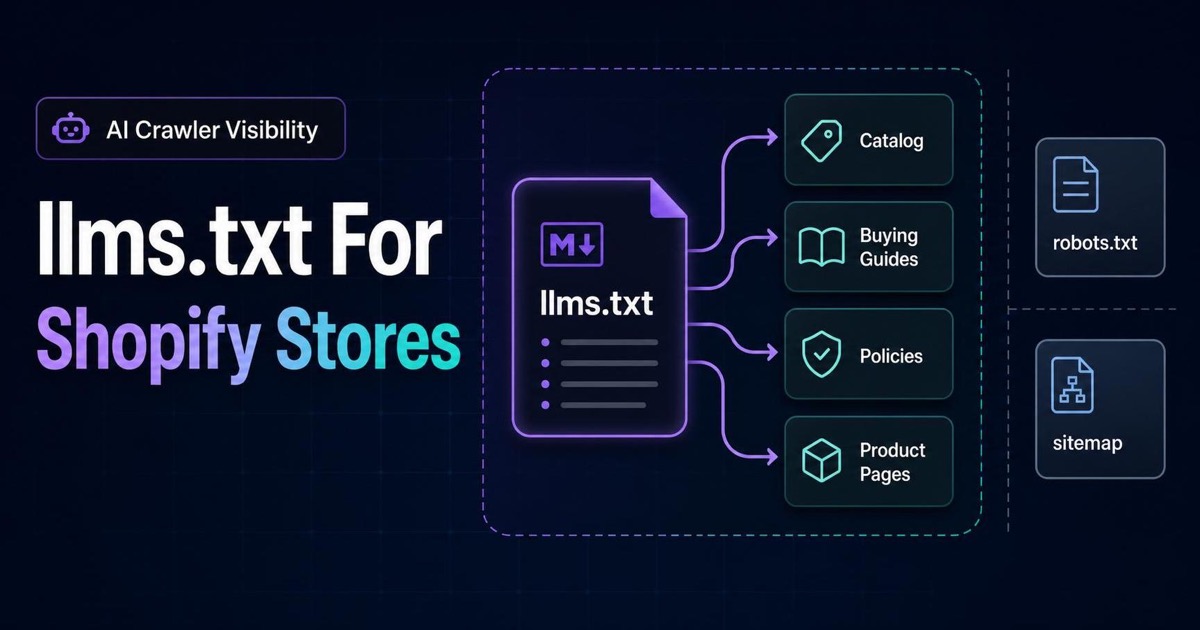
`llms.txt` is an emerging proposal for giving language models a cleaner map of important website content. The idea is simple: place a Markdown file at the root of a website so AI systems can find concise links and context that may be easier to process than a full HTML site.
For Shopify stores, that sounds attractive. Product catalogs, buying guides, policies, and support content are often spread across many templates and apps. A readable file that points AI systems toward the most important content could become useful.
But llms.txt is not a replacement for robots.txt, a sitemap, product schema, or strong product content. It is also not a guarantee that AI platforms will read, honor, cite, or rank your store.
This guide explains what llms.txt is, what it is not, and when Shopify teams should consider it.
What Is llms.txt?
llms.txt is a proposed convention for a Markdown file that sits at a predictable URL, usually:
https://example.com/llms.txtThe file can summarize the site and link to important pages, docs, guides, product information, or other resources that may help language models understand the site more efficiently.
The key word is “proposed.” It is an emerging convention, not a universal standard with guaranteed support across AI platforms.
What llms.txt Is Not
Before adding one, be clear about the limits.
llms.txt is not:
- A guaranteed way to appear in AI answers.
- A replacement for
robots.txtcrawl rules. - A replacement for XML sitemaps.
- A replacement for Product schema or other structured data.
- A place to hide content that is not available elsewhere.
- A substitute for useful product pages, collection pages, guides, and FAQs.
Think of it as a possible orientation file. It can point to useful content. It cannot make weak content authoritative.
llms.txt Vs robots.txt Vs Sitemap
These files solve different problems.
| File | Primary purpose | Typical format | What Shopify teams should remember |
|---|---|---|---|
robots.txt | Gives crawler access instructions. | Plain text rules. | It can allow or disallow crawling patterns, but it does not explain your products. |
| XML sitemap | Lists URLs that should be discoverable. | XML. | It helps discovery of canonical URLs, but it does not summarize page meaning. |
llms.txt | Proposes a readable guide for language models. | Markdown. | It may help orient AI systems if adopted, but support is not universal. |
If you only have time for one thing, do not start with llms.txt. Start by making sure your product pages, structured data, sitemap, and crawl rules are accurate.
Possible Ecommerce Use Cases
A Shopify llms.txt file could eventually be useful for pointing AI systems toward high-value, stable content such as:
- The homepage and brand summary.
- Top product categories.
- Buying guides.
- Size guides.
- Product comparison pages.
- Return, shipping, warranty, and care policies.
- FAQ and support pages.
- Editorial guides that explain product use cases.
For example, a skincare store might link to ingredient guides, skin-type buying guides, product collections, and policy pages. A technical gear store might link to compatibility guides, sizing charts, and comparison pages.
The best candidates are pages that are already useful for humans and stable enough to maintain.
What To Include
If you decide to create an llms.txt file, keep it concise and factual.
A simple structure could include:
# Store Name

Short description of the store, audience, and product category.

## Key Pages

- [Homepage](https://example.com/)
- [Best sellers](https://example.com/collections/best-sellers)
- [Size guide](https://example.com/pages/size-guide)
- [Shipping policy](https://example.com/pages/shipping)

## Buying Guides

- [How to choose the right size](https://example.com/blog/size-guide)
- [Product comparison guide](https://example.com/blog/comparison-guide)
Keep links canonical. Avoid dumping your entire catalog unless there is a clear reason. A sitemap already exists for large URL lists.
What Not To Include
Do not use llms.txt as a promotional keyword document. Avoid:
- Unsupported claims about being the best, most trusted, or most recommended.
- Lists of every product URL without structure.
- Private, hidden, or customer-specific content.
- Outdated campaign pages.
- Contradictory product descriptions.
- Instructions that conflict with
robots.txtor site policies.
If the file becomes noisy, stale, or misleading, it may create more confusion than clarity.
When Shopify Stores Should Use It
Consider llms.txt when these conditions are true:
- Your priority product pages are already clear and crawlable.
- Product schema and sitemap basics are in good shape.
- You have stable buying guides, comparison pages, or help content worth highlighting.
- Someone owns maintenance when products, policies, or category strategy changes.
- You can describe the file as experimental or emerging in internal documentation.
In that scenario, llms.txt can be a low-risk addition to a broader AI-readiness workflow.
When To Wait
Wait if your store still has bigger foundations to fix:
- Product descriptions are thin or duplicated.
- Product schema is missing or inconsistent.
- Important pages are blocked, noindexed, or hard to render.
- Policies and guides are outdated.
- No one owns content maintenance.
- The team expects
llms.txtto directly produce AI citations or rankings.
If those issues exist, focus there first. A clean orientation file will not compensate for unclear pages.
Maintenance Risks
The main risk with llms.txt is drift. A file can be correct on launch day and wrong a month later.
Common drift issues include:
- Links to discontinued collections.
- Outdated policy pages.
- Product claims that no longer match the catalog.
- Buying guides that conflict with new product lines.
- Old campaign pages that should not be highlighted.
Treat llms.txt like a public content surface. Review it after product launches, policy changes, theme migrations, and major content updates.
A Practical Decision Checklist
Before publishing llms.txt, ask:
- Do priority product pages already explain products clearly?
- Is Product schema accurate and aligned with visible content?
- Is the sitemap current?
- Are crawl rules intentional?
- Are the linked guides and policy pages up to date?
- Is every link canonical and public?
- Is someone responsible for quarterly review?
- Are internal expectations clear that support and impact are not guaranteed?
If you cannot answer “yes” to most of these, keep llms.txt on the watchlist and improve the core site first.
Where AnswerAtlas Fits
AnswerAtlas treats llms.txt as one possible signal in a broader readiness workflow. The priority is still the same: make product pages readable, structured data accurate, crawl surfaces clean, and key buying information easy to find.
Before publishing crawler guidance files, run an AI readiness audit. If the audit shows that core pages and product facts are already strong, llms.txt may be worth testing. If not, use the audit to fix the foundations first.
Next step
See how AI-readable your Shopify catalog is.
AnswerAtlas can scan product pages for AI-readiness signals such as structured data, catalog clarity, and crawler-friendly content.
Open Shopify App Store listing