Shopify AEO Checklist: Make Product Pages Easier For AI Answers
Use this Shopify AEO checklist to make product pages clearer for AI answers without relying on ranking guarantees.
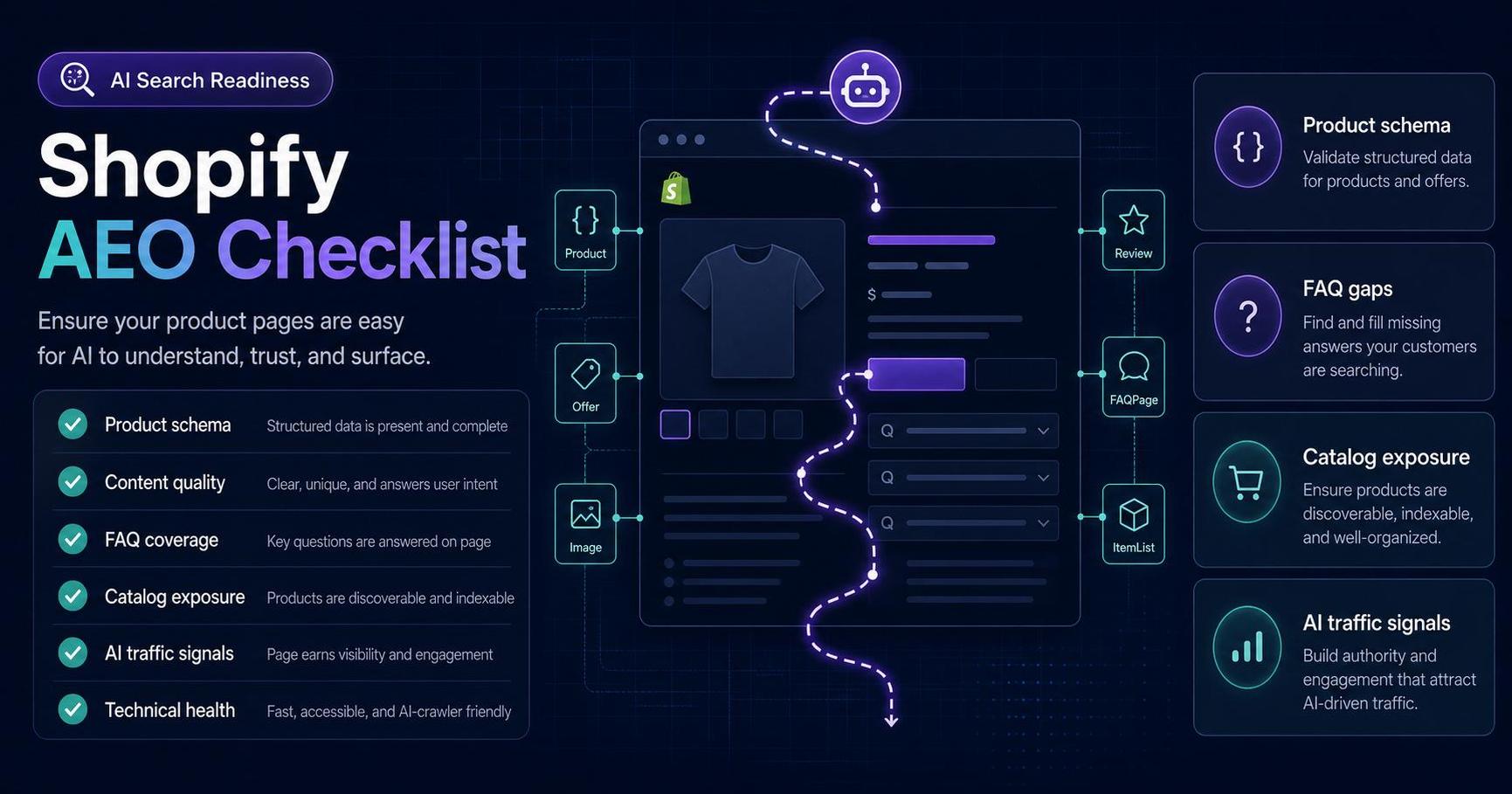
Answer engine optimization is not a magic switch that makes a Shopify store appear in every AI answer. A better way to think about AEO is readiness: can a search engine, crawler, or AI-powered answer system understand what your products are, who they are for, what makes them different, and whether the page can be accessed cleanly?
That makes AEO practical. You are not trying to chase every new interface. You are making product pages easier to read, compare, summarize, and trust.
This checklist is written for Shopify founders, ecommerce operators, and SEO teams that want a concrete starting point before they invest in bigger AI search projects.
The Short Version
Start with your most important product pages and ask five questions:
| Area | What to check | Why it matters |
|---|---|---|
| Product clarity | Does the page explain what the product is and who it helps? | AI answers need clear, specific product facts. |
| Structured data | Do visible product facts match your Product schema? | Schema can reinforce facts when it reflects the page. |
| Comparison context | Can a reader compare size, variant, material, use case, or fit? | AI summaries often need context, not just attributes. |
| Crawlability | Can important content be discovered without blocked scripts or hidden states? | Crawlers cannot summarize what they cannot access. |
| Freshness | Do product facts, availability, reviews, and FAQs stay current? | Outdated product pages create trust and accuracy problems. |
You do not need to complete every item across the whole store at once. Start with your top revenue products, highest-intent collection pages, and pages already receiving organic traffic.
1. Make The Product Easy To Understand
Many Shopify product pages assume the shopper already knows the product. That can work for repeat buyers, but it creates a weak page for AI search systems that need to infer context from the page itself.
Check whether the product page answers these questions near the top of the page:
- What is the product?
- Who is it for?
- What problem, moment, or use case does it support?
- What are the most important variants or options?
- What makes it different from similar products in the catalog?
A thin product description such as “premium everyday backpack with durable materials” is hard to use. A stronger description might explain that the backpack is for commuters who carry a laptop, gym layer, water bottle, and compact tech accessories without needing a separate work bag.
The goal is not longer copy by default. The goal is more useful product facts.
2. Align Visible Content With Product Schema
Product schema is useful when it reflects facts that are also visible and trustworthy on the page. For Shopify stores, common fields include product name, brand, description, image, price, availability, variants, reviews, and ratings.
Use structured data as a QA layer:
- The product name in schema matches the visible page title.
- The description in schema does not contradict the page copy.
- Price and availability are current.
- Variant details are represented clearly on the page.
- Review and rating data is accurate and not stale.
- Images are crawlable and have useful alt text.
Valid schema does not guarantee AI visibility. It helps machines interpret product facts when the rest of the page is also clear. If your visible page says one thing and your structured data says another, fix the source content first.
3. Add Context AI Systems Can Reuse
AI-generated answers often need comparison language, buying criteria, and plain-English explanations. Product pages that only list specs can miss the context a shopper actually needs.
Add sections that help answer common questions:
- Use cases: “Best for small apartments,” “built for trail running,” or “designed for sensitive skin.”
- Fit or compatibility: Sizes, device compatibility, materials, dimensions, or care needs.
- Comparison notes: How this product differs from adjacent products in the same collection.
- Decision criteria: When to choose this option versus another variant.
- Limitations: What the product is not designed for.
Limitations can be especially valuable. A product page that says “not intended for outdoor storage” or “best for laptops up to 14 inches” is easier to trust and easier to summarize accurately.
4. Strengthen FAQs Without Keyword Stuffing
FAQs are useful when they answer real purchase questions. They are weak when they are just a place to repeat keywords.
Good Shopify product FAQ questions include:
- What size should I choose?
- Does this work with a specific device, ingredient sensitivity, or use case?
- How should I clean or maintain it?
- What is included in the box?
- How does this compare with another product in the catalog?
- What shipping, return, or warranty detail affects the buying decision?
Keep answers short and specific. If an FAQ answer requires a long explanation, consider whether it should become a buying guide, comparison post, or collection-page section.
5. Check Crawlability And Rendering Basics
AI readiness still depends on traditional technical foundations. If important content is hidden behind blocked JavaScript, tabs that do not render cleanly, or pages excluded by robots rules, answer systems may not be able to use it.
For priority pages, check:
- The page returns a successful status code.
- Product title, description, price, availability, and canonical URL are present.
- Important text is available in rendered HTML.
- Product images are reachable and not blocked.
- The page is not accidentally noindexed.
- Internal links point to the page from relevant collections, guides, or related products.
- Sitemap entries include canonical product URLs when they should be public.
This is not separate from AEO. It is the foundation that makes AEO work.
6. Build A Monthly AEO Review Habit
AI search changes quickly, but most stores do not need daily panic changes. A monthly review cycle is more useful.
Start with a simple operating rhythm:
1. Pick 10 to 25 priority product pages. 2. Check page clarity, schema alignment, FAQs, and crawlability. 3. Record gaps and assign each one to content, merchandising, SEO, or development. 4. Improve the highest-impact pages first. 5. Recheck after launches, theme changes, app installs, and product catalog updates.
If you already track organic traffic and conversion events, connect AEO improvements to those signals. Do not expect perfect AI visibility data. Treat readiness as an operational score you can improve.
A Practical Shopify AEO Checklist
Use this checklist for each priority page:
- The product title is specific and readable.
- The first paragraph explains what the product is and who it is for.
- The page includes clear use cases or buying criteria.
- Variant differences are explained in plain language.
- Product schema matches visible content.
- Price, availability, image, brand, and review data are current.
- FAQs answer real purchase questions.
- Important content is crawlable and indexable.
- Internal links connect the product to relevant collections or guides.
- The page avoids unsupported claims about AI ranking or visibility.
What Not To Do
Avoid these common AEO mistakes:
- Creating generic AI-written copy that says more but explains less.
- Adding FAQ sections full of repeated keywords.
- Treating schema validation as the whole strategy.
- Publishing claims that AI platforms will cite your store after a single change.
- Updating every product page before learning from a smaller priority set.
The best AEO work usually looks like better product content, cleaner structured data, stronger internal links, and more disciplined review habits.
Where AnswerAtlas Fits
AnswerAtlas helps ecommerce teams turn AI search readiness into a repeatable audit workflow. Instead of guessing which product pages need work, start by identifying pages where product facts, schema, crawlability, and content context are weak.
Use the free AI readiness audit as the first pass. Then prioritize improvements page by page, starting with the products that matter most to revenue, search demand, and customer decision-making.
Next step
See how AI-readable your Shopify catalog is.
AnswerAtlas can scan product pages for AI-readiness signals such as structured data, catalog clarity, and crawler-friendly content.
Open Shopify App Store listing