How To Measure AI Search Visibility Without Guessing
Build a practical AI search visibility report for ecommerce without pretending the data is complete or deterministic.
AI search visibility is hard to measure because the data is fragmented. A shopper may discover a product through an AI answer, an AI-powered search result, a chatbot citation, a shopping agent, a browser summary, or a crawler that never becomes a visible referral.
That does not mean ecommerce teams should ignore measurement. It means the report needs to separate what is directly measurable from what is directional.
A useful AI search visibility report should answer three practical questions:
1. Are priority product and collection pages becoming easier for AI systems to read? 2. Are AI-related crawlers, referrals, or assisted sessions showing up in observable data? 3. Are visitors who arrive through AI-adjacent paths taking valuable actions?
If you can answer those questions consistently, you can improve readiness without claiming guaranteed AI rankings or citations.
Start With Readiness, Not Citations
The most reliable thing you can measure first is not whether ChatGPT, Gemini, Perplexity, or another AI interface mentioned your store today. That signal can be inconsistent, personalized, geography-dependent, or unavailable.
A stronger starting point is readiness: the set of page-level signals that make your catalog easier to understand.
For a Shopify store, readiness usually includes:
- Product titles that clearly say what the product is.
- Product descriptions that explain use case, audience, materials, sizing, compatibility, or differentiators.
- Product schema with accurate name, price, availability, brand, images, offers, and review data where appropriate.
- FAQ or buying-question content that answers real shopper concerns.
- Crawlable product, collection, guide, and policy pages.
- Canonical URLs, sitemap entries, and internal links that expose priority pages.
- Optional orientation files such as
llms.txt, when they point to useful public content.
These signals do not guarantee AI visibility. They give you a practical baseline for whether your catalog is readable enough to deserve visibility.
Separate Direct Signals From Directional Signals
A common measurement mistake is treating every AI-related clue as proof of AI search performance. The better approach is to label signals by confidence level.
| Signal | What it can tell you | What it cannot prove | Confidence |
|---|---|---|---|
| AI referral sessions | Visitors arrived from a known AI or answer interface. | That the answer cited you accurately or exclusively. | Higher |
| Crawler user-agent hits | A crawler requested a page or asset. | That the content was used in an answer. | Medium |
| Readiness score changes | Product pages became easier to parse and summarize. | That AI platforms will reward those changes immediately. | Medium |
| Prompt spot checks | Your brand or products appeared in selected manual prompts. | Stable ranking, broad market visibility, or conversion impact. | Directional |
| Branded search and direct traffic lifts | More people may be looking for your store. | The lift came from AI search specifically. | Directional |
| CTA conversions from AI-focused content | Visitors engaged with your audit, demo, or install path. | That the visitor originally discovered you through AI. | Medium |
This framing keeps the report honest. It also helps teams avoid overreacting to one screenshot from an AI answer or one crawler log entry.
Track Four Measurement Layers
A practical weekly report can use four layers: readiness, crawlability, referral activity, and conversion intent.
1. Readiness Metrics
Readiness metrics measure whether the catalog is becoming clearer.
Examples:
- Percent of priority product pages with complete Product schema.
- Percent of priority products with useful descriptions rather than duplicate vendor copy.
- Number of product pages with missing or stale availability data.
- Number of pages with buyer-question content or FAQ sections.
- Number of collections or guides linked from sitemap, navigation, or
llms.txt.
This layer is usually the most actionable. If a product page is missing price, availability, variant context, or useful product facts, the next step is clear.
2. Crawlability And Access Metrics
Crawlability metrics measure whether important pages can be discovered and requested.
Examples:
- Priority product pages included in sitemap.
- Important pages blocked by
robots.txt, noindex, broken canonicals, or redirects. - Server logs or analytics events showing crawler requests from known AI-adjacent user agents.
- Pages returning 200, 3xx, 4xx, or 5xx status codes to crawler requests.
Crawler activity is not the same as AI visibility. It is a sign that access may be happening. You still need good content and structured data once the crawler arrives.
3. Referral And Session Metrics
Referral metrics measure observable visitors from AI-related surfaces.
Examples:
- Sessions from known AI or answer-engine referrers.
- Landing pages receiving those sessions.
- Engagement from those sessions: time on page, scroll depth, add-to-cart, form submit, install click, or pricing CTA.
- Revenue or assisted revenue when attribution is available.
These metrics are useful but incomplete. Some AI interfaces may not pass clean referrer data. Some visitors may copy a URL or arrive through a browser that masks the source.
4. Conversion Intent Metrics
Conversion intent tells you whether AI-search content is creating useful buyer or merchant actions.
For AnswerAtlas-style landing pages, that can include:
- Free audit CTA clicks.
- Early-access requests.
- Blog CTA clicks.
- Pricing plan interest.
- Demo or agency inquiry submissions.
- Store URL submissions for audit follow-up.
This layer is important because visibility is only useful if it turns into learning, qualified leads, installs, or revenue.
Build A Weekly Reporting Template
A simple weekly report is better than a complicated dashboard nobody trusts.
| Report section | Metric | Source | Owner | Weekly question |
|---|---|---|---|---|
| Readiness | Priority PDPs with complete schema | Audit checklist or app scan | SEO / ecommerce | Did more priority products become machine-readable? |
| Readiness | Product pages with buyer-question content | Content QA | Merchandising / content | Are we answering questions shoppers ask before buying? |
| Crawlability | Priority pages returning 200 | Crawl/log review | Technical SEO | Can important pages be accessed cleanly? |
| Crawlability | AI-adjacent crawler requests | Server logs or platform logs | Technical SEO | Are crawler requests reaching useful pages? |
| Referrals | AI-related sessions | Analytics | Growth | Are observable AI referrals appearing? |
| Referrals | AI referral landing pages | Analytics | Growth | Which product, collection, or guide pages attract sessions? |
| Conversion | Free audit or demo CTA clicks | Event tracking | Growth / product | Are visitors taking the next step? |
| Conversion | Early-access or install intent | Form/API data | Product | Which content or CTA produces qualified interest? |
Use this as a rhythm, not a scoreboard. If one number is noisy, look for patterns across the other layers.
Avoid These Measurement Traps
Treating Prompt Checks As Rankings
Manual prompt checks can be useful for research, but they are not stable rankings. AI answers can change by model, date, location, session, prompt wording, and browsing context.
Use prompt checks as qualitative evidence. Do not make them the only KPI.
Treating Crawler Hits As Citations
A crawler request means a system requested a URL. It does not mean the page was indexed, summarized, cited, or used in a shopping recommendation.
Crawler visibility matters, but it is an input signal.
Reporting AI Traffic Without Source Caveats
Some AI interfaces pass referrers. Others may not. Some sessions may appear as direct traffic. Some browser or privacy settings may remove source detail.
Report what you can see, and label the blind spots.
Measuring Everything Before Fixing Basics
If product schema is broken, descriptions are thin, availability is stale, or important pages are blocked, the measurement dashboard will mostly tell you what you already know: the catalog is not ready.
Fix the basics while the report matures.
What To Do First
If you are starting from zero, use this order:
1. Pick 20 priority product pages. 2. Check schema, descriptions, availability, FAQ coverage, canonical URLs, and sitemap inclusion. 3. Add event tracking for audit, pricing, demo, and blog CTA clicks. 4. Watch for known AI-related referrers and crawler requests, but label them as incomplete signals. 5. Review the same report weekly and note which fixes were shipped.
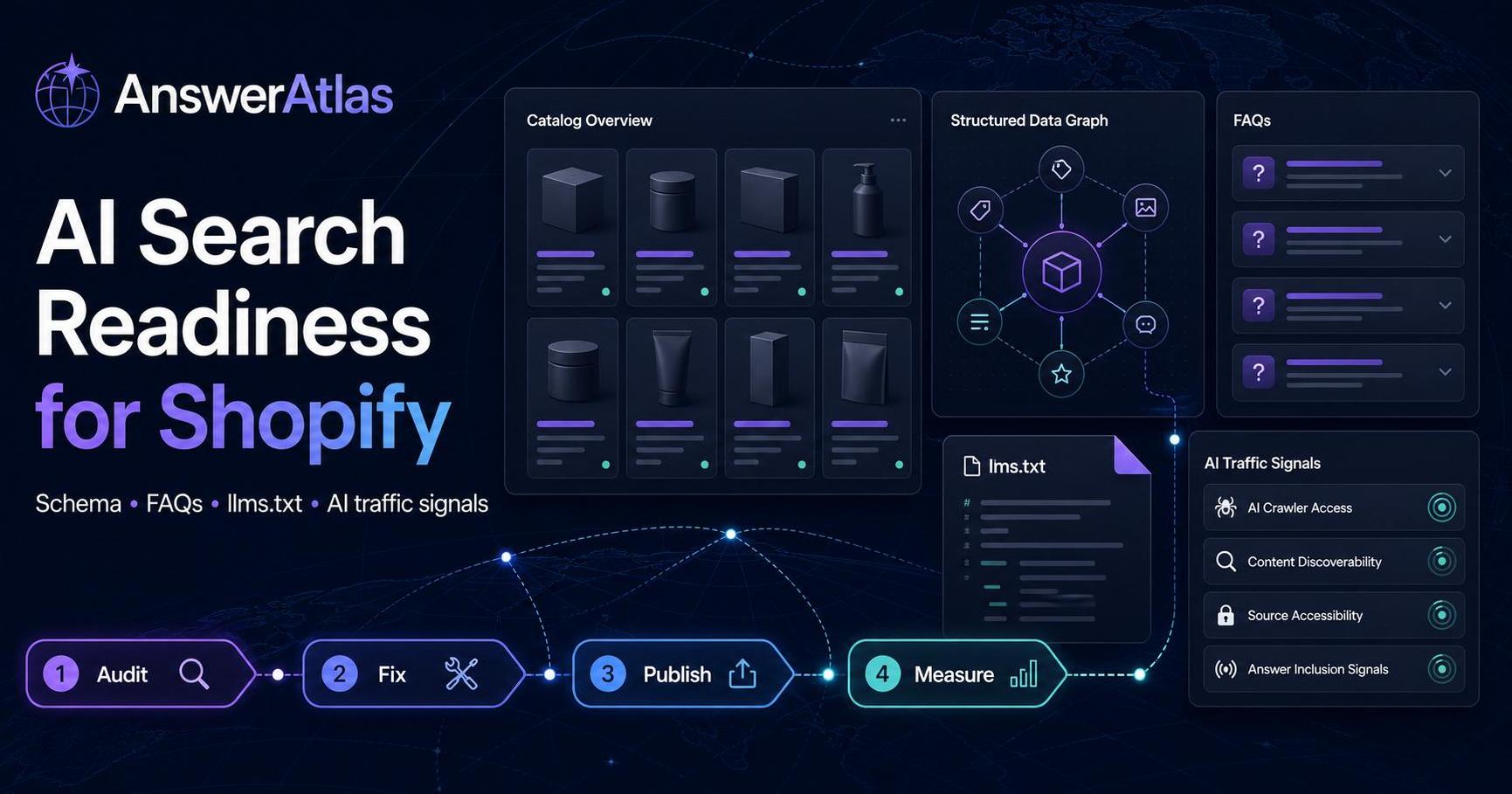
The goal is not to prove that AI search is perfectly measurable today. The goal is to create a trustworthy loop: audit, fix, publish, measure, and repeat.
How AnswerAtlas Fits
AnswerAtlas is being built around that loop. Instead of promising instant AI citations, the product focuses on the signals ecommerce teams can improve: product data clarity, schema coverage, FAQ gaps, catalog exposure, crawler-readable content, and AI traffic signals.
If your team wants to understand where the catalog is readable and where it is still unclear, start with a readiness audit. Measurement becomes more useful once the underlying product pages are worth measuring.
Next step
See how AI-readable your Shopify catalog is.
AnswerAtlas can scan product pages for AI-readiness signals such as structured data, catalog clarity, and crawler-friendly content.
Open Shopify App Store listing