AI Search Optimization Vs SEO For Shopify: What Changes
Compare AI Search Optimization and traditional SEO for Shopify, including shared foundations, new readiness work, and what teams should not abandon.
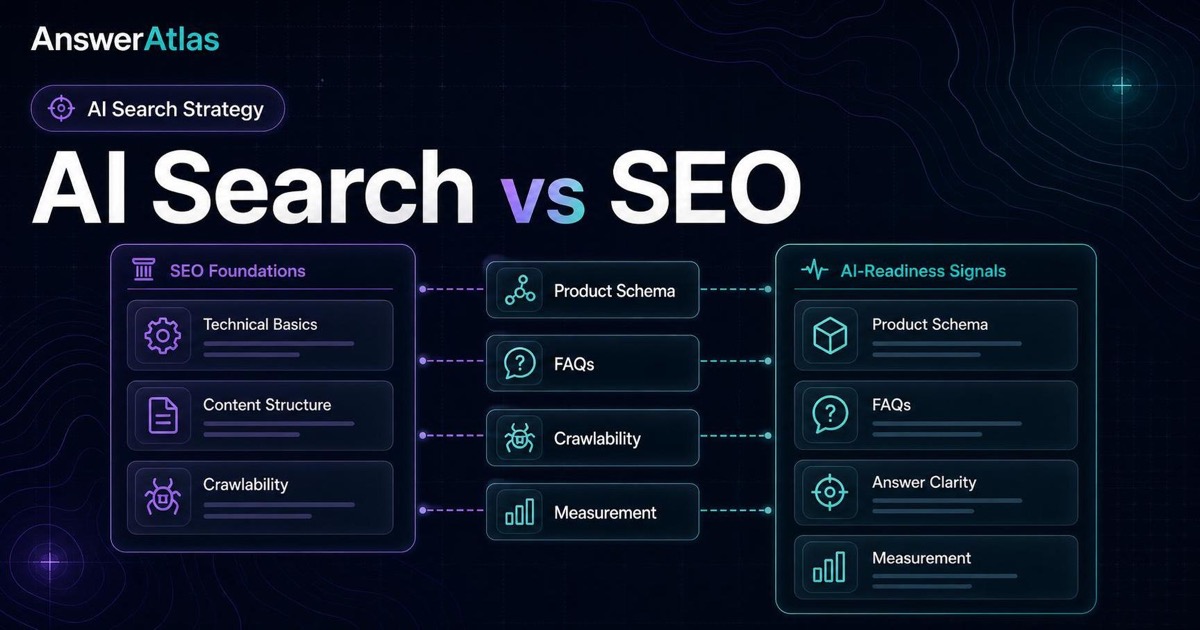
AI Search Optimization is not a replacement for traditional SEO. For Shopify stores, the safer way to think about it is as an extension of SEO: the same crawlability, content quality, structured data, and technical foundations still matter, but the work now needs to account for AI answers, shopping agents, summaries, and catalog-level understanding.
That distinction matters because some teams hear "AI search" and assume the old playbook is obsolete. It is not. Product pages still need to load, index, convert, and explain the offer clearly. Category pages still need useful content. Structured data still needs to match visible facts. Internal links still help discovery.
What changes is the standard for clarity. AI systems do not just need pages that can rank. They need product information that can be read, compared, summarized, and trusted.
The Short Version
Traditional SEO helps Shopify pages get discovered and evaluated in search. AI Search Optimization helps product and catalog information become easier for AI-powered systems to understand and reuse.
| Area | Traditional SEO focus | AI Search Optimization focus |
|---|---|---|
| Crawlability | Can search engines access and index the page? | Can AI-related crawlers and retrieval systems access useful product context? |
| Keywords | Does the page match search demand? | Does the page answer the product questions behind the query? |
| Content | Is the page relevant, useful, and competitive? | Is the product easy to summarize, compare, and trust? |
| Structured data | Does schema support rich results and product understanding? | Does schema align with visible product facts and reduce ambiguity? |
| Measurement | Rankings, impressions, organic sessions, conversions. | Readiness scores, crawler signals, AI referrals, assisted conversions, prompt spot checks. |
| Operating model | SEO audits, content updates, technical fixes. | Catalog readiness audits, product facts QA, FAQ gaps, llms.txt orientation, AI visibility monitoring. |
The best plan does both. Do not abandon SEO basics. Add AI-readiness work where it improves product understanding.
What Stays The Same
Most fundamentals still matter because AI search does not remove the need for clean, accessible, useful pages.
Crawlability Still Matters
If important product pages are blocked, broken, slow, redirected poorly, or excluded from indexes, AI-readiness work starts on weak ground.
Shopify teams should still check:
robots.txtaccess rules.- Sitemap coverage.
- Canonical URLs.
- Noindex tags.
- Redirect chains.
- 404 and 500 errors.
- Rendered HTML for important product facts.
AI systems cannot reliably summarize what they cannot access.
Useful Content Still Matters
Traditional SEO already rewards useful content over thin pages. AI search raises the same issue in a different format.
A product page with vague copy such as "premium quality for everyday use" is weak for shoppers, weak for SEO, and weak for AI summaries. A page that explains audience, use case, dimensions, materials, variants, limitations, and FAQs is stronger across all three.
Structured Data Still Matters
Product schema remains one of the clearest machine-readable signals for Shopify stores. But valid schema is not enough if it contradicts the page.
Keep checking:
- Product name.
- Description.
- Brand.
- Price and currency.
- Availability.
- Images.
- Offers.
- Reviews and ratings when legitimate and visible.
- Variant handling.
The SEO and AI-readiness principle is the same: structured data should reinforce visible content, not replace it.
Internal Links Still Matter
Internal links help search engines and users discover important pages. They also help machines understand relationships across products, collections, guides, policies, and FAQs.
For Shopify, useful internal links often connect:
- Product pages to collection pages.
- Collection pages to buying guides.
- Product FAQs to policy pages.
- Comparison posts to related products.
- Blog guides to audit or readiness CTAs.
Do not treat internal links as only an SEO tactic. They are also a catalog map.
What Changes With AI Search Optimization
AI Search Optimization adds a sharper focus on product understanding.
Product Pages Need More Decision Context
Traditional SEO might ask whether the page targets the right query. AI-readiness asks whether the page can answer the shopper's decision.
For example:
- Who is this product for?
- What problem does it solve?
- How does it compare with nearby options?
- Which variant should someone choose?
- What are the limitations?
- What facts need to be trusted before purchase?
This is why product content gaps matter. The page needs to explain the product well enough to be summarized accurately.
Catalog Consistency Becomes More Important
AI systems may connect signals across multiple pages. If a product title, schema description, collection copy, FAQ, and metadata all say slightly different things, the catalog becomes harder to interpret.
Shopify teams should look for consistency across:
- Product title and URL.
- Visible product description.
- Product schema.
- Meta title and description.
- Collection descriptions.
- Reviews, FAQs, and support content.
- Inventory and availability states.
The goal is not identical copy everywhere. The goal is aligned facts.
FAQs Should Answer Buyer Questions, Not Keywords
FAQ sections built only for keywords are usually weak. AI-readiness favors concise, specific answers to real buyer questions.
Better FAQ questions include:
- Will this fit a 14-inch laptop?
- Is this ingredient safe for sensitive skin?
- Which size should I choose?
- What is included in the box?
- How does this compare with the premium version?
- What warranty or return detail affects the purchase?
These answers improve the page for shoppers and make product context easier to reuse.
Measurement Becomes Less Deterministic
Traditional SEO measurement already has uncertainty, but it still has familiar signals: rankings, impressions, clicks, organic sessions, and conversions.
AI search measurement is more fragmented. You may see:
- Known AI referral sessions.
- AI-related crawler requests.
- Prompt spot-check results.
- Readiness score changes.
- Branded search changes.
- Assisted conversions from AI-focused content.
None of these prove guaranteed AI visibility. They are directional signals that need careful labels and caveats.
What Not To Abandon
The biggest mistake is using AI search as a reason to ignore proven SEO work.
Do not abandon:
- Technical SEO audits.
- Product schema QA.
- Core Web Vitals and page performance work.
- Useful category and product content.
- Internal linking.
- Metadata quality.
- Search Console and analytics reporting.
- Conversion rate optimization.
- Merchandising judgment.
AI Search Optimization should make these workflows more product-aware, not replace them with vague AI tactics.
A Phased Shopify Operating Model
Most teams do not need a separate AI-search department on day one. They need a phased operating model that fits existing ecommerce work.
Phase 1: Audit Priority Pages
Start with 10 to 25 high-value products and collections.
Check:
- Product clarity.
- Schema alignment.
- Variant explanations.
- FAQ gaps.
- Crawlability.
- Sitemap and canonical coverage.
- Internal links.
This gives the team a concrete readiness baseline.
Phase 2: Fix Product Understanding
Turn the audit into content and technical improvements.
Examples:
- Rewrite thin descriptions with specific use cases.
- Add comparison notes between similar products.
- Clarify variant differences.
- Align Product schema with visible facts.
- Add buyer-question FAQs.
- Improve collection page introductions.
This phase should feel like better merchandising and better SEO, not a separate AI gimmick.
Phase 3: Publish Orientation Signals
Once priority pages are useful, improve discovery and orientation.
That may include:
- Cleaner sitemap coverage.
- Stronger internal links.
- Buying guides or comparison posts.
- Optional
llms.txtpointing to useful public pages. - Updated metadata and Open Graph assets.
Do this after the pages themselves are worth pointing to.
Phase 4: Monitor With Caveats
Build a lightweight report that separates reliable signals from directional signals.
Track:
- Readiness improvements.
- Crawler access patterns.
- AI-related referrers when visible.
- Blog and audit CTA clicks.
- Conversion events from AI-search content.
- Manual prompt spot checks, clearly labeled as directional.
Use the report to prioritize the next fixes. Do not use it to claim guaranteed rankings, citations, or revenue.
How SEO And AI Search Work Together
For Shopify stores, the strongest approach is integrated:
1. Use SEO research to understand demand. 2. Use product and merchandising knowledge to clarify the offer. 3. Use schema and technical SEO to expose accurate facts. 4. Use AI-readiness checks to find ambiguity in the catalog. 5. Use analytics to learn which content and CTAs create useful action.
This keeps AI Search Optimization grounded in work the team can control.
Where AnswerAtlas Fits
AnswerAtlas is being built around that practical overlap. The goal is not to replace SEO tools or promise instant AI citations. The goal is to help Shopify teams audit whether their product catalog is clear, structured, crawlable, and measurable enough for AI-powered search experiences.
Start with a readiness audit. If the audit shows thin product copy, schema mismatches, missing FAQs, or weak collection context, fix those first. The result should be a stronger catalog for shoppers, search engines, and AI systems at the same time.
Next step
See how AI-readable your Shopify catalog is.
AnswerAtlas can scan product pages for AI-readiness signals such as structured data, catalog clarity, and crawler-friendly content.
Open Shopify App Store listing